THE HUMANOID ECONOMY
What physical AI means for investment, industry, and the future of work.

published by

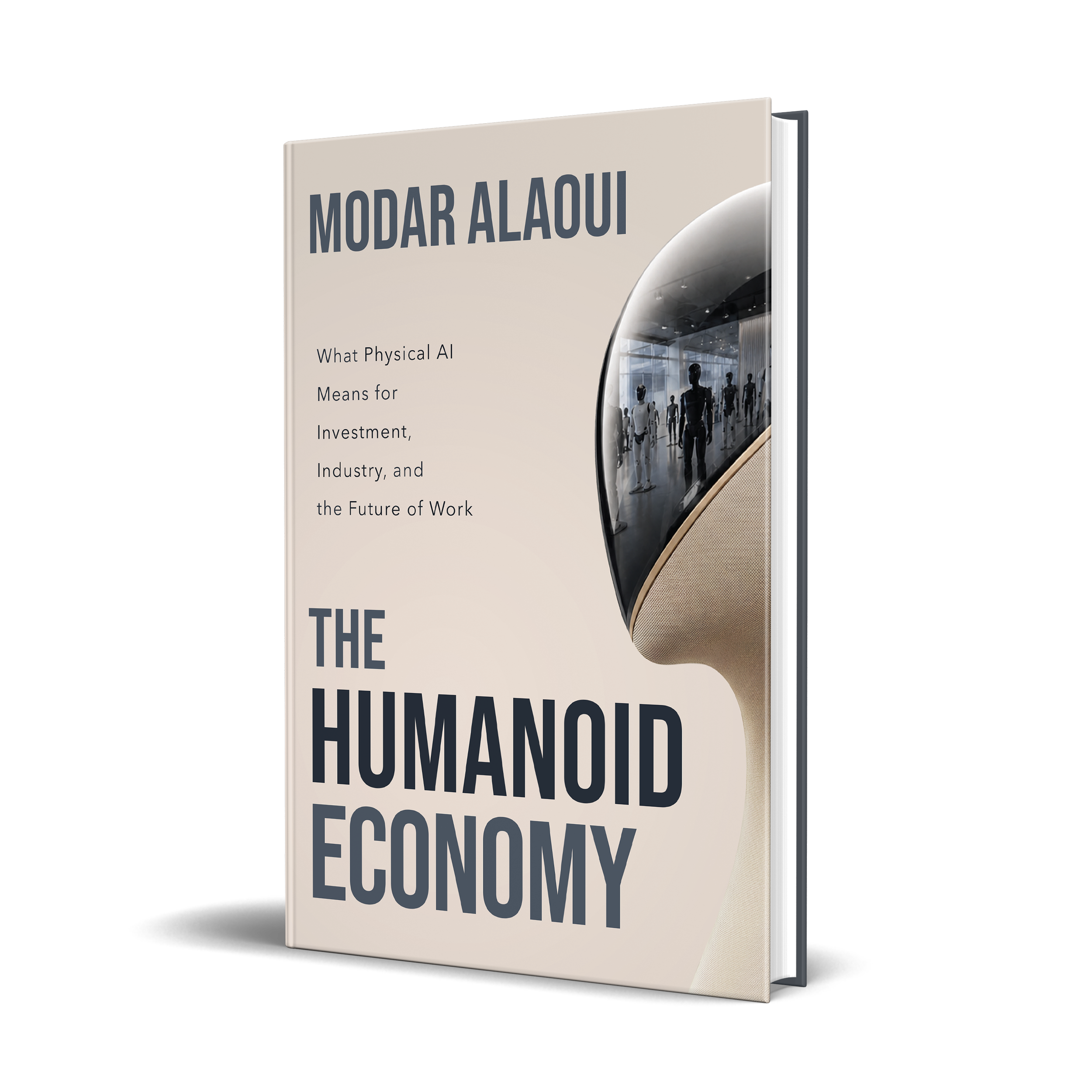
ABOUT the bookWHEN PHYSICAL AI
BECOMES AN ECONOMY
The Humanoid Economy is the emerging economic system taking shape around humanoid robots and Physical AI, spanning technology, capital, manufacturing, infrastructure, policy, labor markets, and human adoption.
The economic opportunity could extend beyond the mobile and internet economies combined, driven by the capabilities humanoids unlock, the infrastructure built around them, and the labor markets they reshape.
Physical AI is becoming more than an industry. It is becoming an economy.
Drawing on Modar Alaoui’s early role in building the emerging humanoid robotics ecosystem as an investor, industry builder, and convener, The Humanoid Economy examines why humanoids are emerging, the infrastructure to bring them into the world, and what it takes to build and fund them.
It reveals the forces shaping adoption, from technology and capital to human acceptance, work, policy, and global competition, and how they are giving rise to a new economy.
The book offers a framework for navigating what comes next.
endorsementsFROM
LEADERS
IN THE FIELD
-
“Humanoid robots are not simply new machines—they represent a new way for humans and intelligent systems to interact. In The Humanoid Economy, Modar Alaoui brings together the technological, economic, and societal forces driving this transformation, offering an important perspective on where the field is headed.”
-
“The Humanoid Economy captures a pivotal moment in robotics. Modar Alaoui explains why advances in AI, hardware, standards, and deployment are converging to create new opportunities across industries. Whether you're an executive, investor, policymaker, or engineer, this book offers valuable insight into one of the fastest-moving sectors in technology.”
-
“Alaoui makes clear that the next trillion dollars of industrial investment won't be won by hardware alone—it will go to those who build the capital, standards, and trust that let humanoids operate safely in the human world. The Humanoid Economy provides a timely and compelling vision for responsible innovation at scale.”
-
“In The Humanoid Economy, Modar Alaoui presents a compelling vision of a future where humanoids participate in an entirely new kind of economy. He brilliantly frames these machines not as replacements for people, but as tools that unlock new possibilities, amplify human labor, and ultimately elevate humanity.”
-
“Humanoid robotics represents far more than another generation of industrial automation. The Humanoid Economy explains why advances in physical AI, systems integration, and commercialization are bringing humanoids from research into the real world. Modar Alaoui offers a compelling perspective on the technologies, markets, and ecosystem driving this transformation.”
FOR INVESTORS, BUSINESS LEADERS, BUILDERS, AND POLICYMAKERS WHO WANT TO UNDERSTAND THE NEW ECONOMY TAKING SHAPE AROUND HUMANOID ROBOTICS.
where to buy







OTHER EDITIONS
AUDIOBOOK
Narrated by Brandon Pollock

简 体 中 文 版 | SIMPLIFIED CHINESE
Licensed to CITIC Press Corporation
Release Date 2027

about the author
MODAR ALAOUI
Modar Alaoui is the founder and general partner of ALM Ventures, a Silicon Valley venture capital firm focused on humanoids, physical AI, and spatial intelligence. He is also the founder and chair of the Humanoids Summit, a global forum for leaders shaping humanoid robotics, with editions in Silicon Valley, Tokyo, Seoul, London, and other regions worldwide.
He is founder and chair of the Bay Area Robotics Association (BARA) and creator of International Humanoids Day, advancing “humanoids for humanity” through ethical development, global standards, international collaboration, and responsible real-world deployment. He also contributes to policy efforts shaping U.S. national humanoid strategy and long-term leadership and competitiveness in physical AI.
Earlier in his career, Modar founded Eyeris, where he developed computer vision and sensor-fusion AI systems for in-cabin sensing in autonomous and highly automated vehicles, combining software and hardware across perception and edge compute. He studied behavioral science and communication at Concordia University in Montreal, a foundation for his work in human behavior understanding and machine perception.
His work and perspectives have been featured in Bloomberg, CNBC, The Wall Street Journal, Reuters, Wired, Scientific American, The New Yorker, and Forbes. In The Humanoid Economy, he draws on his early role in building the humanoid robotics ecosystem to examine the new economy taking shape around physical AI.
chaptersINSIDE
THE HUMANOID
ECONOMY
-
Why the human form fits a world designed for people and how sensing, familiarity, and acceptance shape adoption.
-
How disconnected advances in AI, hardware, capital, and industry began converging into a viable humanoid ecosystem.
-
The investment, industry platforms, standards, regional networks, and policy needed to support deployment at scale.
-
How sensing, actuation, compute, manipulation, and locomotion must work together, and why integration remains difficult.
-
Why physical AI requires a different investment model, new measures of progress, and a better understanding of risk.
-
How trust, fear, work, and human acceptance shape whether humanoids succeed outside the lab.
-
How national strategy, governance, standards, and international coordination will shape the future of humanoid robotics.
BUILDING THE HUMANOID ECONOMY
Through Investment, Industry, and Global Engagement
Founder & General Partner
Founder & Chair
Founder & Chair
creator